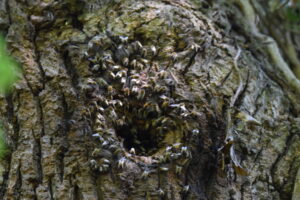
Wild honey bee colonies—both truly wild (in trees and buildings) and simulated wild (in small hives)—were studied to determine their life-history traits, to see if these traits have changed now that these colonies are infested with Varroa destructor . Most colonies (97%) survive summers, but only 23% of founder (first-year) colonies and 84% of established colonies survive winters. Established colonies have a mean lifespan of 5–6 years and most (87%) have a queen turnover (probably by swarming) each summer. A population model shows that these life-history traits produce a stable population of colonies. Remarkably, the suite of colony life-history traits found in the 2010s (with V. destructor ) matches that found in the 1970s (without V. destructor ). It seems likely that the wild colonies living near Ithaca, NY, possess defenses against V. destructor that are not costly.
Martin Ott ist überzeugt: Wir wissen genug, um ökologische Krisen zu lösen. Was fehlt, ist die Beziehung zu diesem Wi...
Wildlebende Honigbienen brauchen alte Bäume mit Höhlen und strukturreiche Wälder. Darüber schreiben Raphaèle Piaget, ...
Important information
Important information: The original texts are published in German. The French, Italian and English versions are translated automatically and checked where possible. Please report any errors to bee@freethebees.ch.